Compliance corner: Getting ready for the EEO-1 data collection deadline

The deadline to file the 2024 EEO-1 Component 1 report is Tuesday, June 24, 2025.

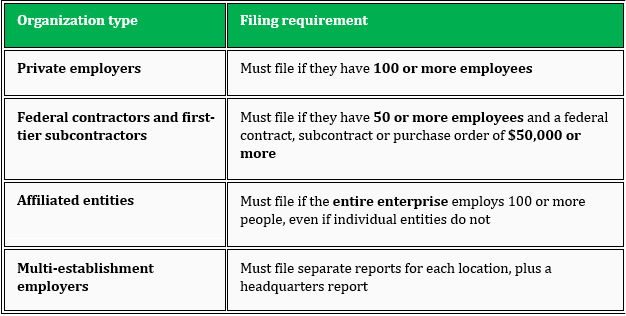
This applies to:

  • Private employers with 100 or more employees
  • Federal contractors with 50 or more employees and a qualifying contract

Who needs to file EEO-1 reports each year?
Important points

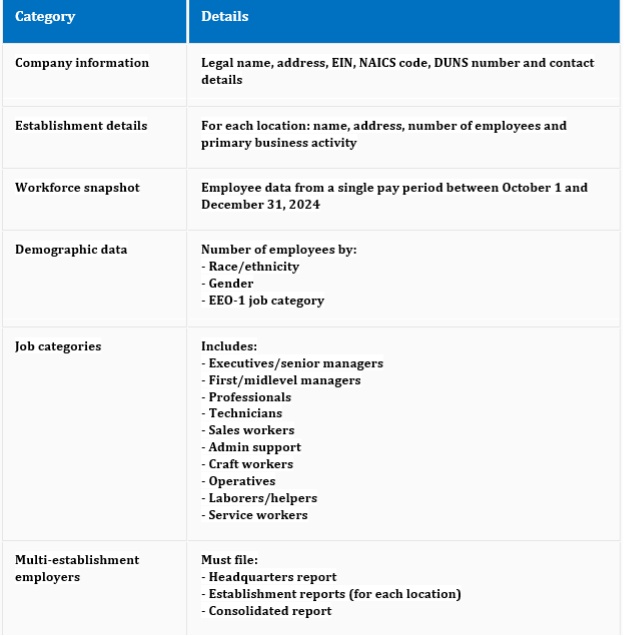
Required information for EEO-1 filing

You can file and find official guidance at the EEOC’s portal: EEO-1 Component 1 filing portal.

Prepare your data

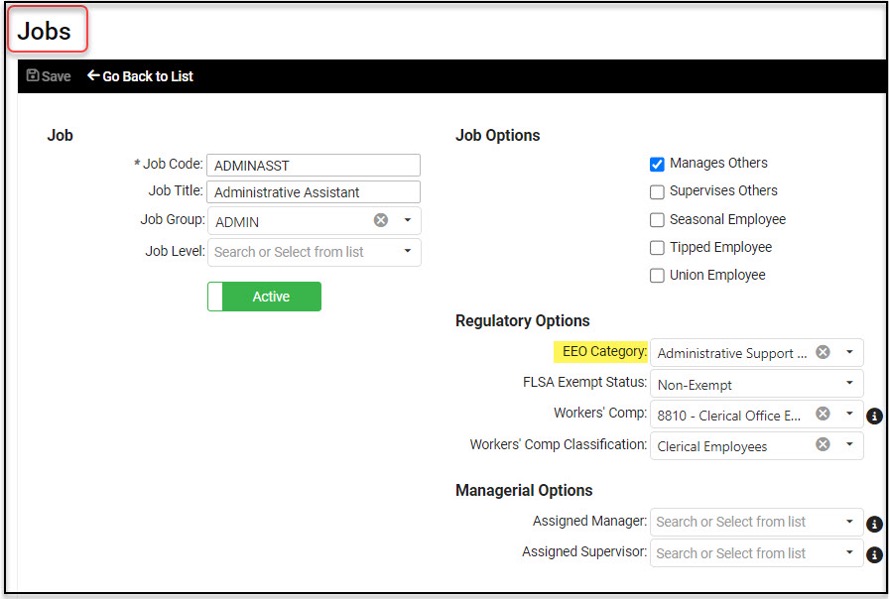
Requirement one:  All jobs must have an EEO category assigned.

Navigate to Client Management > Job > Jobs and ensure the EEO category is populated for all your jobs in isolved. Don’t forget to check any jobs that may be inactive as well. If the job was active in the prior calendar year, it will need to have an EEO category assigned.
Requirements two and three: All employees must have a gender and ethnic origin assigned.

An easy way to identify where updates are needed is to run the EEO-1 report. Navigate to Reporting > Client Reports and select a report category of HR – Compliance to filter your report list. Select the EEO1 Report – As-Of Date and enter the following report criteria:

  • As-Of Date: Enter the period end date for the payroll you select to use for EEO reporting. This pay period must fall between Oct. 1 and Dec. 31 of the reporting year.
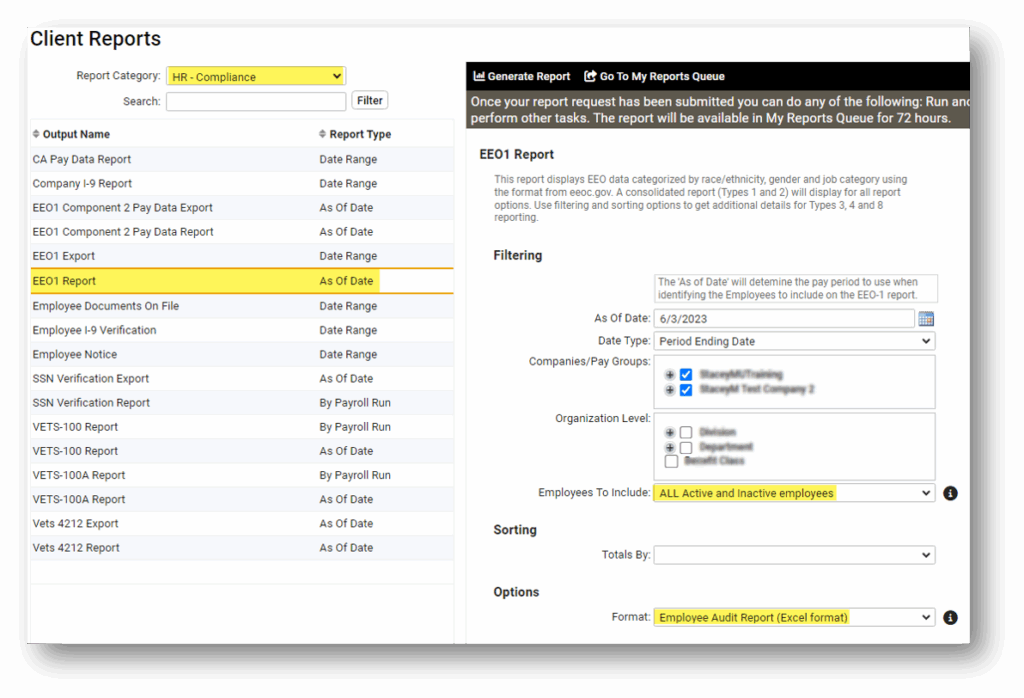
  • Date Type: Select Period Ending Date.
  • Employees to Include: Keep the default ALL Active and Inactive employees.
  • Select the Employee Audit Report (Excel format).

When viewing the report, page down and you will see a list of errors that need correction:

  • All employees must be assigned an EEO job category.
  • All employees must have a gender and ethnic origin.

Update your data

Ask your employees to add missing gender or ethnic origin data through employee self-service.

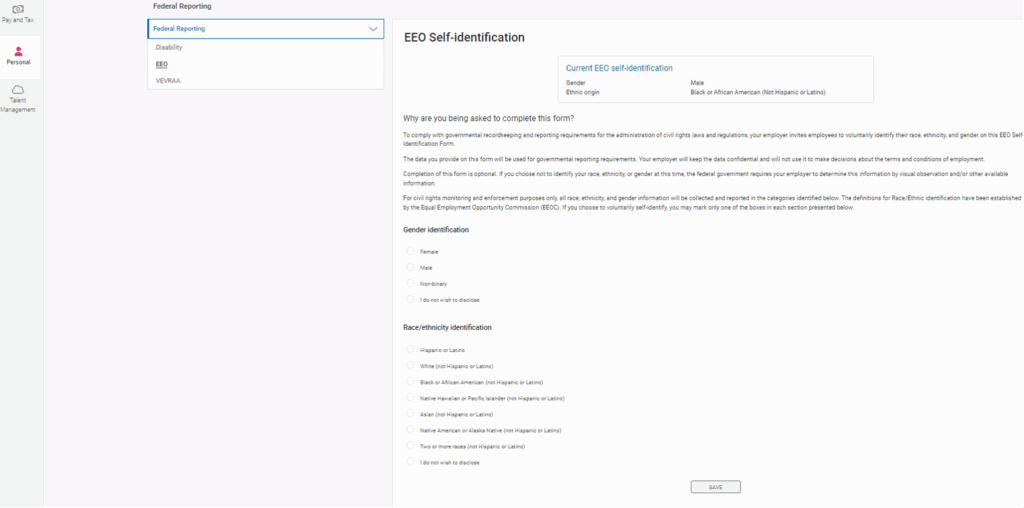
For clients using the modern adaptive employee experience, employees will navigate to Personal > Personal Information > Federal Reporting > EEO to update their gender and race/ethnicity identification selections. They will be able to see their current self-reported status and make updates on any device, including phones, tablets and computers.
For clients using employee self-service in classic view, employees will navigate to Employee Self-Service > Federal Reporting Data > EEO Self-Identification to update their gender and race/ethnicity identification selections.
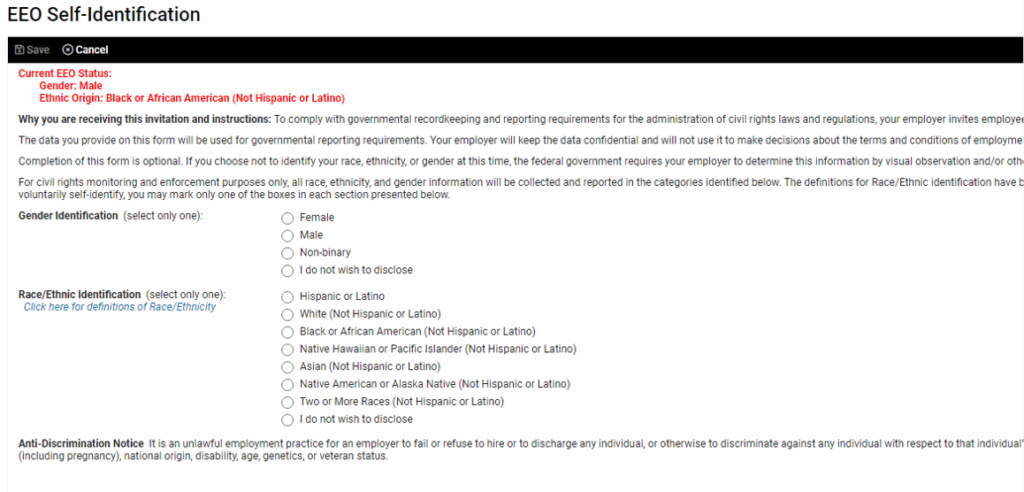
Please note: If an employee is uncomfortable answering the questions, they can select the option “I do not wish to disclose,” but the field cannot be left blank.

If your employees do not have access to make these updates, contact your payroll specialist and they will enable the appropriate security roles.

Ensure all work locations are tied to an establishment

The Establishments screen links the work locations to their respective EEO-1 reporting establishments.

Navigate to Client Management > Client Maintenance > Establishments and ensure all your work locations are tied to an establishment in isolved. If you already have an establishment created, verify that all your work locations are associated with the establishment. If you need to create an establishment, click the Add New button to create your establishment and then select the work locations that you want to tie to your establishment.

To use the isolved EEO1 Report or EEO1 Export, you need to link your work locations to EEO establishments and assign your company headquarters on the Establishments screen for accurate reporting.
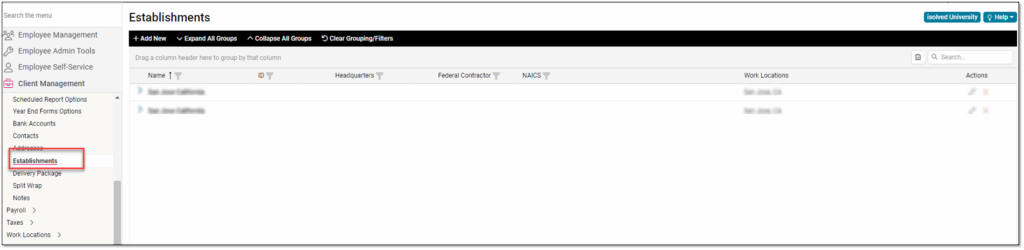
If you are a multi-establishment employer, make sure you designate one of your establishments as your headquarters to enable the type 3 headquarters report.

Run your EEO-1 audit report

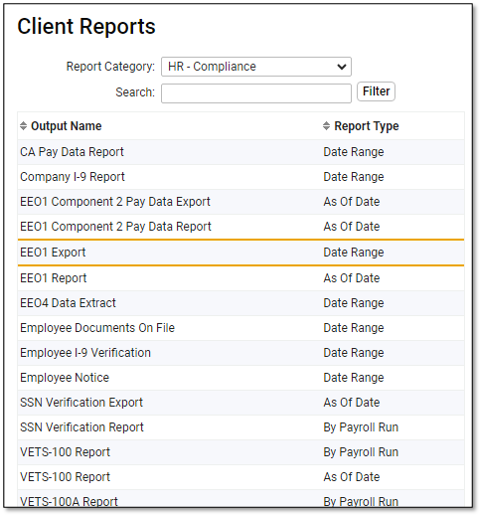
Run your EEO1 employee audit report again to verify all your data has been updated. Look good? Now you are ready to run your EEO1 export report. Navigate to Reporting > Client Reports and select the report category HR – Compliance to easily access the EEO-1 reports in isolved and submit your data through the EEO-1 Data Collection Portal.

For companies tracking ethnic origin, gender and EEO classifications in isolved, the EEO1 Export is formatted as a comma-delimited (CSV) file for upload to the EEO-1 Component 1 online filing system. This report is available on the Reports > Client Reports menu in the HR Compliance Reports category.
Prenatal leave gets a boost: NYC’s new 20-hour benefit explained

The New York City final rules on paid prenatal personal leave incorporate state-level requirements into the city’s existing Earned Safe and Sick Time Act (ESSTA). Here’s a summary of the key provisions.

Overview

  • Separate leave bank: Employees are entitled to a distinct bank of 20 hours of paid prenatal personal leave per 52-week calendar period.
  • Eligibility: This applies to all employees covered under New York State labor law, regardless of employer size.
  • Purpose: Leave is intended for prenatal health care and related needs before childbirth. It cannot be used for postnatal care.
  • Compensation: Employees must be paid at their regular rate of pay or the minimum wage, whichever is higher.
  • Integration with ESSTA: The rule formally integrates these state-level requirements into NYC’s ESSTA framework, ensuring consistency in enforcement and compliance.
  • Employer obligations: Employers must update policies, track leave separately from other sick or safe time and comply with notice and documentation rules.

The integration of New York state’s paid prenatal personal leave into the NYC Earned Safe and Sick Time Act marks a significant step forward in supporting pregnant employees. By providing a separate bank of 20 hours of paid prenatal leave, the rule ensures that expectant workers have dedicated time for essential prenatal care – without reducing their existing sick or safe leave. Employers should review and update their leave policies to ensure compliance by the Jan. 1, 2025, effective date.

For full details, refer to the official NYC Department of Consumer and Worker Protection page: NYC Paid Safe and Sick Leave Law – Including Prenatal Leave.

The information provided here is intended for informational purposes only and should not be construed as legal advice. We strongly recommend consulting with a qualified legal professional for any legal advice pertaining to your company.

Alaska paid sick leave: What employers need to know

Starting July 1, 2025, Alaska will implement a new paid sick leave law as part of Ballot Measure 1, which was passed in the 2024 general election. This law requires all employers to provide paid sick leave to their employees, including part-time and overtime-exempt employees.

Key provisions 

  • Accrual rate: Employees will earn at least one hour of paid sick leave for every 30 hours worked.  
  • Usage: Employees can use their accrued sick leave for personal illness, medical appointments or to care for a sick family member.  
  • Annual cap: Employees can earn up to 56 hours of paid sick leave per year. 
  • Carryover: Unused sick leave can be carried over to the next year, but employers may cap the total accrued leave at 56 hours.  

For more detailed information, you can visit the Alaska Department of Labor and Workforce Development’s FAQ page.  

This information is provided solely for informational purposes and does not constitute legal advice or create an attorney-client relationship. Its content is general in nature and may not address individual circumstances or specific legal issues. Insperity does not interpret clients’ retirement plan documents and does not administer, have discretionary or act as a fiduciary of any client-sponsored retirement plans. For legal advice tailored to your situation, please consult with your legal counsel.

Vermont Pay Transparency Law: Promoting fair pay disclosure

Effective July 1, 2025, Vermont’s Pay Transparency Law (Act 155) will require employers to disclose compensation or the range of compensation in written job advertisements. This law is designed to ensure equity and openness in the hiring process. 

Key provisions 

  • Disclosure requirement: Employers with five or more employees must include the expected compensation or range of compensation in job advertisements. 
  • Applicability: The law applies to all written job advertisements for positions physically located in Vermont or remote jobs predominantly performed in Vermont. 
  • Exemptions: Jobs paid on a commission or tipped basis must disclose that fact but are not required to list specific compensation ranges. 

For more detailed information, you can visit the Vermont Attorney General’s Guidance on Act 155

This information is provided solely for informational purposes and does not constitute legal advice or create an attorney-client relationship. Its content is general in nature and may not address individual circumstances or specific legal issues. Insperity does not interpret clients’ retirement plan documents and does not administer, have discretionary or act as a fiduciary of any client-sponsored retirement plans. For legal advice tailored to your situation, please consult with your legal counsel.

California implements new AI regulations

As of Jan. 1, 2025, California has implemented a series of groundbreaking AI regulations promoting transparency, privacy and ethical practices across various industries. These new laws position California at the forefront of AI governance, ensuring that the rapid development and integration of AI technologies are conducted responsibly. 

Key highlights of the regulations 

  1. Transparency and accountability: Businesses must disclose AI system usage in decision-making to ensure awareness and accountability. 
  2. Data privacy: AI-generated data is considered personal information according to California’s data privacy laws. Businesses are required to adhere to strict data protection standards to ensure that AI systems maintain consumer privacy.  
  3. Protection against misuse: California’s laws include provisions to prevent the misuse of AI. These measures are intended to safeguard individuals and the integrity of public discourse. 

Looking ahead 

California’s AI regulations promote responsible AI use. Compliance helps businesses avoid legal issues and build stakeholder trust, fostering sustainable growth in an AI-driven future. 

For more detailed information, you can visit the California Department of Justice’s official page on AI regulations.  

This information is provided solely for informational purposes and does not constitute legal advice or create an attorney-client relationship. Its content is general in nature and may not address individual circumstances or specific legal issues. Insperity does not interpret clients’ retirement plan documents and does not administer, have discretionary or act as a fiduciary of any client-sponsored retirement plans. For legal advice tailored to your situation, please consult with your legal counsel.

Michigan’s Earned Sick Time Act takes effect with last-minute changes

On Feb. 21, 2025, Michigan Gov. Gretchen Whitmer signed a significant amendment to the Earned Sick Time Act (ESTA), introducing several employer-friendly changes just as the law was set to take effect. This 11th-hour modification comes after a long legal battle that saw the Michigan Supreme Court rule the previous adopt-and-amend approach unconstitutional in July 2024.

Key changes to the ESTA:

  1. Implementation timeline: 
    • The law is effective immediately for most employers. 
    • Small businesses with 10 or fewer employees have until Oct. 1, 2025, to comply. 
  2. Coverage and exemptions: 
    • All employers are now covered, and there are different provisions for those with 10 or fewer employees. 
    • New businesses are exempt for the first three years of operation. 
    • Certain employee categories are now excluded, including those who set their own hours, unpaid interns and youth employees. 
  3. Accrual and usage: 
    • Employees accrue one hour of paid sick time for every 30 hours worked. 
    • Employers can opt to front-load sick time at the beginning of the year. 
    • Usage caps are set at 72 hours per year for larger employers and 40 hours for small businesses. 
  4. Carryover and documentation: 
    • No carryover is required if employers front-load time. 
    • Employers using accrual methods must allow carryover of up to 72 hours (40 for small businesses). 
    • Employees must provide documentation within 15 days if requested for absences exceeding three consecutive days. 
  5. Legal recourse: 
    • The amendment removes the private right of action, allowing only administrative complaints for recourse. 

Employers should review their current policies and make necessary adjustments to ensure compliance with the amended ESTA. It’s advisable to consult with legal counsel to navigate these changes effectively.  As Michigan adjusts to the new sick leave requirements, it is essential for businesses to stay informed and ready to implement these updated regulations. The ESTA signifies a substantial change in employee benefits, seeking to offer more extensive sick leave coverage while addressing employer considerations. 

Missouri employers: Important update on paid sick leave law

Effective May 1, 2025, Missouri’s new Earned Paid Sick Time law will take effect. Here are the key details employers need to know:

  1. Coverage 
    • Applies to all private employers in Missouri 
    • Excludes federal and state government entities 
    • Some employee categories are exempt (e.g., certain nonprofit workers and employees in retail/service businesses with annual gross sales below $500,000) 
  2. Accrual and usage 
    • Employees earn one hour of paid sick leave for every 30 hours worked 
    • Accrual begins May 1, 2025, or upon hire (whichever is later) 
    • There is no waiting period, so employees can use sick time as it accrues 
  3. Annual limits 
    • Employers with 15+ employees: 56 hours of use per year 
    • Employers with fewer than 15 employees: 40 hours of use per year 
  4. Carryover and front-loading 
    • Up to 80 hours of unused sick leave can carry over to the next year 
    • Employers may front-load sick leave at the beginning of the year 
    • If front-loading, unused time must be paid out at year-end 
  5. Permitted uses 
    • An employee’s or their family member’s physical/mental health care 
    • Absences due to domestic violence, sexual assault or stalking 
    • Closures of workplace or schools due to public health emergencies 
  6. Employer requirements 
    • Display a workplace poster by April 15, 2025 
    • Provide individual notice to employees within 14 days of hire 
    • Maintain records for at least three years 
  7. Next steps 
    • Review and update your existing PTO policies 
    • Prepare for implementation by May 1, 2025 
    • Watch for potential legal challenges or legislative changes 

ACA reporting requirements simplified: New laws bring relief to employers

In a significant move to streamline Affordable Care Act reporting, former President Joe Biden signed two crucial pieces of legislation on Dec. 23, 2024: the Paperwork Burden Reduction Act and the Employer Reporting Improvement Act. These laws introduce welcome changes that will ease the administrative load on employers starting with the 2024 reporting year. 

Summary of key changes: 

  1. Forms 1095-B and 1095-C are now available by request 
    • Employers are no longer required to automatically distribute these forms to all employees.  
    • Employers must provide a clear, conspicuous and accessible notice to inform employees of their right to request the forms. 
    • When requested, employers must furnish the forms by Jan. 31 of the following year or within 30 days of the request, whichever is later. 
  2. Enhanced electronic delivery options 
    • Employers can now more broadly distribute Forms 1095-B and 1095-C electronically. 
    • Employees who have previously consented to electronic delivery are considered to have ongoing consent unless they explicitly revoke it. 
  3. Extended response time for IRS penalty assessments 
    • The deadline for employers to respond to proposed ACA penalty assessments (Letter 226-J) has been extended from 30 to 90 days. 
  4. New statute of limitations 
    • A six-year statute of limitations has been established for collecting ACA-related assessments. 
  5. Flexibility in reporting 
    • Employers can now substitute an employee’s date of birth for their tax identification number when the TIN is unavailable. 

What this means for employers: 

These changes significantly reduce the paperwork burden and offer more flexibility in ACA reporting. However, it’s crucial to note that employers must still prepare and file Forms 1095-C and 1095-B with the IRS by the usual deadlines. 

Next steps: 

  • Update your ACA reporting processes to align with these new requirements. 
  • Prepare to provide clear notices to employees about form availability. 
  • Review and update electronic delivery consent procedures. 

Remember: State-specific reporting requirements may still apply. Employers should consult with their legal and tax advisors to ensure full compliance with both federal and state regulations. 

Stay tuned for further guidance from the IRS on implementing these new provisions. As we navigate these changes together, the simplification of ACA reporting promises to bring welcome relief. 

This information is provided solely for informational purposes and does not constitute legal advice or create an attorney-client relationship. Its content is general in nature and may not address individual circumstances or specific legal issues. Insperity does not interpret clients’ retirement plan documents and does not administer, have discretionary or act as a fiduciary of any client-sponsored retirement plans. For legal advice tailored to your situation, please consult with your legal counsel.

Sick leave compliance corner

Massachusetts sick leave and pregnancy loss

Effective Nov. 21, 2024, Massachusetts will implement new provisions regarding sick leave related to pregnancy loss. Here are the key details:  

  1. Eligibility: Employees who experience pregnancy loss will be entitled to use their accrued sick leave under the Massachusetts Earned Sick Time law. This applies to all employees, including part-time and temporary workers.
  2. Sick leave accrual: Employees can earn up to 40 hours of paid sick time per calendar year, accruing one hour for every 30 hours worked. Employers with 11 or more employees must provide paid sick time, while those with fewer than 11 are required to provide sick time but it does not have to be paid.
  3. Notification requirements: Employees must notify their employers of the need to use sick time, typically requiring advance notice unless in emergencies.
  4. Documentation: While employers can request documentation for absences longer than three consecutive days, they cannot ask for details regarding the specific medical condition or situation related to the use of sick leave.

This new provision reflects Massachusetts’s commitment to supporting employees during difficult times and ensuring they have access to necessary leave for recovery from pregnancy loss. Employers should review and update their sick-leave policies accordingly to comply with these changes.

This information is provided solely for informational purposes and does not constitute legal advice or create an attorney-client relationship. Its content is general in nature and may not address individual circumstances or specific legal issues. Insperity does not interpret clients’ retirement plan documents and does not administer, have discretionary or act as a fiduciary of any client-sponsored retirement plans. For legal advice tailored to your situation, please consult with your legal counsel.

Time off to vote compliance corner

Time off to vote: How does your state rank?

In many states, legislation mandates that employers must grant their employees time off to participate in elections. In these locations, employers cannot punish workers for taking voting leave, although some states may require prior notification for the leave to be protected. State regulations differ regarding the length of the time off, the specific requirements that must be fulfilled, whether the leave must be compensated and the notice employees are obligated to provide. Read Time off to vote: How does your state rank? in the Insperity® Help Center for details and voting requirements by state.